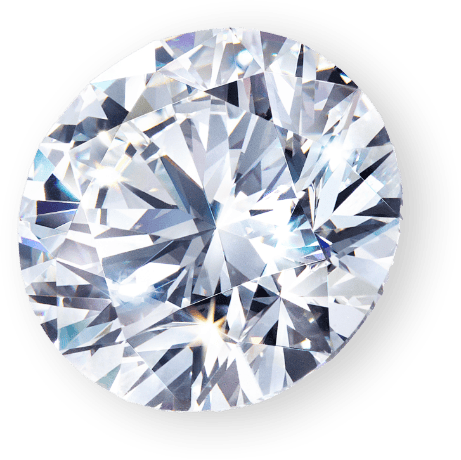
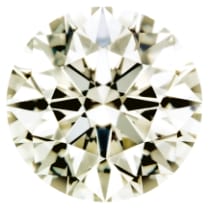
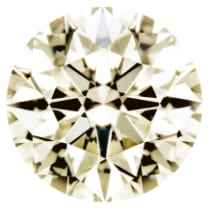
The '4Cs' are an international appraisal criteria for diamonds prescribed by the GIA (Gemological Institute of America). TASAKI sends its graders for diamond appraisal and discernment courses at the GIA. Based on the criteria learned there, we set even more stringent in-house standards to ensure that our professionals preserve the TASAKI diamond quality.
CUT
CARAT
CLARITY
COLOUR
Based on the 4Cs, we set even more stringent in-house standards
01 CUT
We use only
3EX
02 CARAT
We use only
0.20ct
or higher
03 CLARITY
We use only
VS2
or higher
04 COLOUR
We use only
H
or higher
1. Girdle diameter (100%)
2. Star length (50 - 60%)
3. Table (53 - 58%)
4. Crown angle (33° - 35°)
5. Pavilion angle (40.6° - 41.6°)
6. Lower half length (75 - 80%)
7. Culet
8. Crown height (14.5 - 16%)
9. Girdle thickness
10. Pavilion depth (42.5 - 43.5%)
11. Depth (59.2 - 62.4%)
Proportions are set assuming girdle diameter of 100%.
One of the most common diamond cuts is the round brilliant cut, which is evaluated according to five grades, with the Excellent grade being the highest. The grades are based on three items, namely proportions (general evaluation of the cut), polish (state of surface polish), and symmetry.
By improving our cutting techniques even further, TASAKI went on to achieve a 3EX (Triple Excellent) cut, which represents the top grade in all three of the grading categories mentioned, and we now produce 3EX for 100 percent of the diamonds we cut. Only these 3EX diamonds are used for TASAKI BRIDAL pieces.
Proportions
General cut appraisal
Excellent
Polish
Surface polishing state
Excellent
Symmetry
Excellent
Carat, the unit used in measuring
the weight of a diamond
A carat is equivalent to 0.2g. Since the girdle diameter is determined in the rough stone stage, at least 10 percent more carats can be obtained by cutting with a thick girdle. However, a surprising amount of brilliance is lost when a diamond is cut with a thick girdle.
TASAKI attaches more importance to maximum brilliance than weight when cutting diamonds according to its own ideal proportions, which are established according to each girdle diameter.
Diamonds with no discernable inclusions or blemishes interfering with the passage of light through the diamond receive the grade FL (flawless), with 11 grades following, depending on the number and size of inclusions. TASAKI BRIDAL uses only diamonds achieving a grade of VS2 or higher.
| FL | Flawless | No internal or external flaws |
|
| IF | Internally Flawless |
No internal flaws |
|
| VVS1 | Very Very Slightly Included |
Inclusions are difficult to detect at 10X magnification |
|
| VVS2 | |||
| VS1 | Very Slightly Included |
Inclusions are slightly difficult to detect at 10X magnification |
|
| VS2 | |||
| SI1 | Slightly Included |
Inclusions can be easily detected at 10X magnification, but are difficult to detect with the naked eye |
|
| SI2 | |||
| I1 | Included | Inclusions can be easily detected with the naked eye |
|
| I2 | |||
| I3 |
Diamonds with no discernable inclusions or blemishes interfering with the passage of light through the diamond receive the grade FL (flawless), with 11 grades following, depending on the number and size of inclusions. TASAKI BRIDAL uses only diamonds achieving a grade of VS2 or higher.
TASAKI has set its own clarity grading system (appraisal standards) for diamonds that have already been graded by an external appraisal institution. In cases of diamonds that are on the borderline between two grades, we judge strictly at the lower grade. In doing so, we ensure that our grading standards remain reliable.
In colour grading, appraisal is conducted by a diamond grader under an appropriate light source.
Colour is rated according to 23 grades from the highest grade of D (colourless and totally transparent) to Z, depending on the yellowness of the stone.
Only diamonds of grade H (close to colourless) or higher are accepted for the TASAKI BRIDAL range.
Some diamonds have strong fluorescent properties that make them glow when they absorb ultraviolet light. However, they appear cloudy under natural light, so TASAKI checks for fluorescence at the rough diamond stage, and uses only diamonds that have little or no fluorescence.