


or
Are you an Amazon customer? Pay now with address and payment details stored in your Amazon account.
A society of mass production, mass consumption, and mass disposal causes environmental problems such as the depletion of natural resources and a shortage of waste treatment plants. TASAKI will promote initiatives to reduce the extraction of finite natural resources and control its waste volumes to help realize a recycling-based society.
TASAKI is promoting initiatives to make effective use of Akoya oysters after the pearls have been harvested.
After harvest, the shells are either given away free of charge to companies that specialize in processing them into decorative items such as buttons, or they are re-purposed as weights for rafts at our pearl farms. The adductor muscles are consumed as food. We have also adopted a novel approach to sustainability and introduced the appeal of pearls from different angles, such as arranging for paintings featuring artist’s chalk made from powdered shells.
We conduct repairs of our pearl farm’s materials so that they can be used for as long as possible, to minimize the amount that goes to waste.
We also actively use recyclable materials in the display tools at our stores. The in-store display tools used during the 2020/2021 holiday season were collected and crushed, after which they were shipped to glass factories in various regions and recycled into road pavement materials. The in-store display tools used during the 2021/2022 holiday season were also collected and sent to recycling facilities and recycled into fuel for on-site power generation and hydrogen generation.
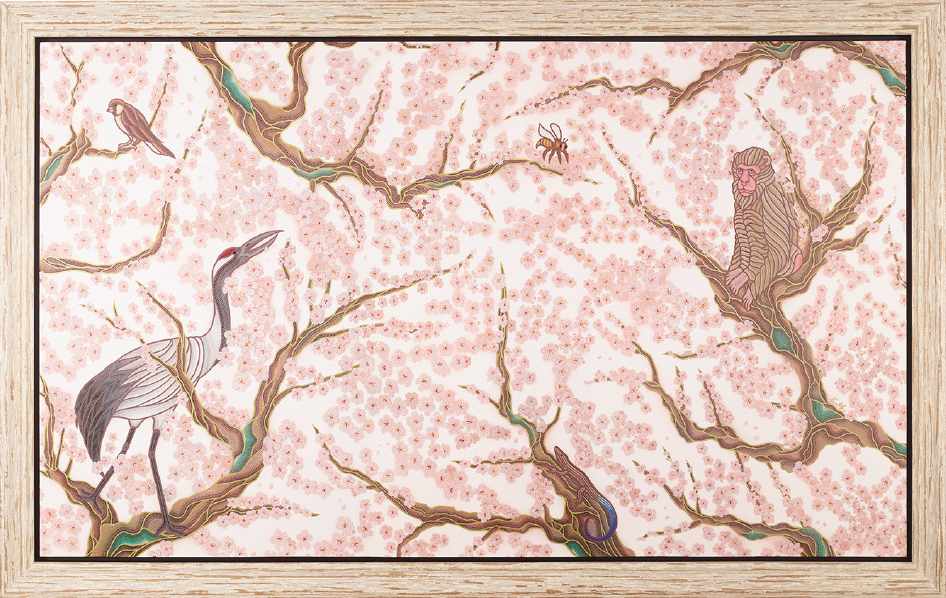
“桜 cherryblossom”
Painted with artist’s chalk extracted from pearl oysters by contemporary artist, Ben Mori. First displayed at the “SAKURA inspired by Japonism” event held at the Ginza Main Store in March 2022.
©Ben Mori
Our aim for 2030 is to be a jewellery brand that co-exists with nature by switching to renewable energy, achieving zero emissions, and conserving ecosystems, to protect the marine and mining environments that help create our precious jewellery.
Editorial Policy
Scope of report
The information in this report primarily covers TASAKI & Co., Ltd. Where other Group companies are included, this is made clear in the text. All references to “TASAKI” in the text refer to TASAKI & Co., Ltd.
Period covered by this report
Most of the information provided in this report concerns the period from November 1, 2021 to October 31, 2022, the fiscal year of TASAKI & Co., Ltd. However, the qualitative information contains some information covering the period from fiscal 2021 and earlier or fiscal 2023. In such cases, this is clearly stated in the text.
Publication Timing
Publication date: August 23, 2023
Guidelines referenced
GRI / ISO 26000
Forward-looking statements/Disclaimer
Forward-looking statements found in this report are based on information obtained by TASAKI until the publication of the report and certain assumptions determined to be reasonable. They are not intended as a guarantee by TASAKI, and for various reasons, actual results may differ considerably from the forward-looking statements contained herein.

