


or
Are you an Amazon customer? Pay now with address and payment details stored in your Amazon account.
TASAKI positions compliance and risk management as key factors of its management and has established manuals for each division to implement and monitor, with group-wide rules taking the highest precedence.
When a potential risk is identified, the relevant division reports to management, promptly evaluates response measures, and takes action to mitigate the risk.
The group-wide Risk and Compliance Rules define, “risk” in detail as follows.
Product risk
Defects, counterfeiting, and theft of our products
Customer and business partner risk
Inquiries, claims, protests, complaints
Employee risk
Workplace injuries, occupational health and safety, accidents, infringements of law, crimes (victim or perpetrator)
Corporate value risk
Infringements of laws, compliance violations, governance violations (including anti-corruption)
Accident and disaster risk
Traffic/aircraft accidents, weather disasters, earthquakes, fires, theft
Harassment risk
Harassment as perpetrator, victim, or witness
Management risk
Operational errors, operational misconduct, difficulties in securing required headcounts
Information leak risk
Information system breakdown, misconduct by executive or employee
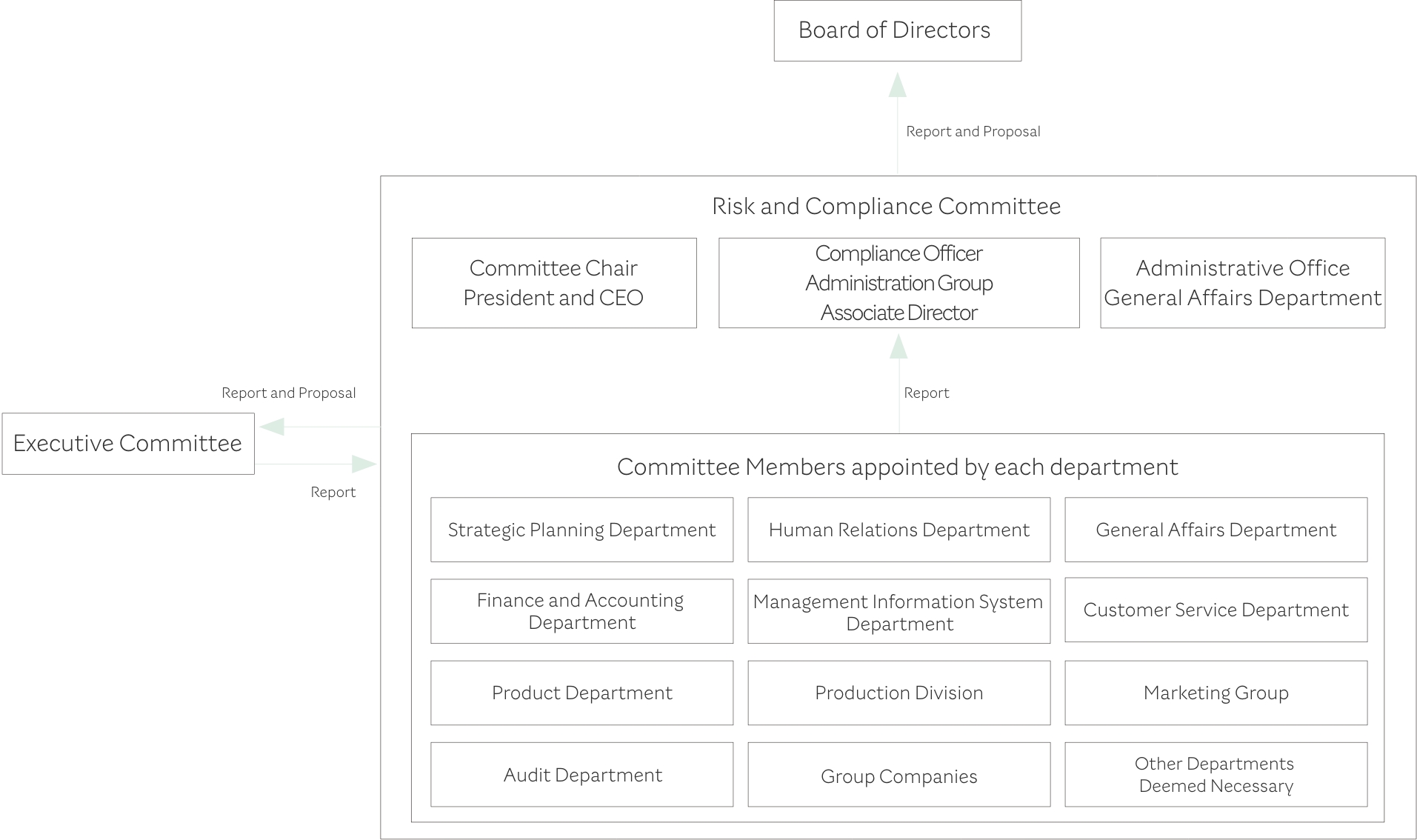
The Company has established a Risk and Compliance Committee, chaired by the Representative Director and President, to oversee compliance and risk management across the organisation, including its group companies.
The Risk and Compliance Committee has the General Affairs Department as its Administrative Office and comprises the Committee Chair, the Compliance Officer and employees selected by the Committee Chair from the Strategic Planning Department Human Relations Department, General Affairs Department, Finance and Accounting Department, Management Information System Department, Customer Service Department, Audit Department, and other departments deemed necessary.
The roles of the Risk and Compliance Committee are the formulation of basic policies on risk management and compliance, information gathering, drafting of various measures such as activities to raise awareness about compliance, and responses in the event that a risk manifests or a compliance problem occurs.
At least once every three months, individual committee members report on the risk and compliance situation within their respective departments. These reports are compiled by the Administrative Office and submitted to management.
The Committee also convene by convocation notice when deemed necessary by the Committee Chair or Compliance Officer.
The Committee Chair or Compliance Officer also report to the Board of Directors any matters that they deem necessary.
TASAKI has introduced a whistleblower system to accept reports or requests for advice regarding infringements of laws and regulations or company rules and implement appropriate responses.
The system has contact points within and outside the company, and whistleblowers are protected against any disadvantageous treatment under the Whistleblower Protection Act.
The details of reports will be fully investigated internally, and if any material facts related to compliance are uncovered, action will be taken according to the company’s rules.
This system is also available to employees of subsidiaries.
At TASAKI, we conduct compliance training by e-learning once a year, targeting all executives and employees, to increase concern about compliance among executives and employees and provide them with accurate knowledge.
We also monitor developments in the revision and abolition of laws and regulations relevant to our business by subscribing to specialist trade journals and communicating closely with our legal counsel.
The outcomes of this monitoring are communicated to employees via departmental meetings and compliance training.
TASAKI has stipulated in our Rules Concerning the Elimination of Anti-social Forces that it will have no relationship whatsoever with anti-social forces and that it will not comply in any way with unreasonable demands made by such groups.
We screen new and existing trading partners to determine whether they constitute an anti-social force and, depending on the outcome of such screening, make a decision on whether or not to prohibit trading with them.
We also conduct background checks of officer candidates regarding associations with anti-social forces and ask all elected officers to submit a written declaration.
We conduct checks to determine whether employees have any association with anti-social forces, and require them to submit a written declaration that they will have no such associations whatsoever.
TASAKI positions the protection of customers’ personal information as a material issue, and, in addition to setting forth our basic policy in the form of internal Rules for the Protection of Personal Information, we work to educate and raise awareness among executives and employees and to secure our security structures.
Our Policy for the Protection of Personal Information (Privacy Policy) is published on the TASAKI brand website.
TASAKI thoroughly communicates information regarding the protection of personal information in its compliance e-learning program. The same content is included in training for new employees.
We also publish articles about information security in the in-house newsletter on an occasional basis to further raise awareness throughout the group.
In terms of technical measures, TASAKI has established a firewall for the protection of personal information that it holds to exclude access by external parties.
We have also introduced email filtering software and endpoint security software on the PCs of all officers and employees.
Further, we conduct regular checks of the management structures of stores that have many opportunities to obtain personal information.
At TASAKI, any confirmed or potential violation of the Personal Information Protection Regulations must be reported promptly to the Personal Information Protection Manager.
Upon receiving such a report, the Personal Information Protection Manager verifies the details and, if a violation is confirmed, escalates the matter to the Representative Director and President and directs the relevant departments to take appropriate corrective action.
In the event of unauthorized access to the brand website or elsewhere, an unauthorized program, or similar incident, due to the urgent need for investigation of the causes and emergency action based on specialist knowledge, the relevant departments will cooperate in making a response.
By 2030, we will practice transparent management under a diverse governance structure and build a structure that will enable us, as a luxury brand, to make decisions that will lead society.

Editorial Policy
Scope of report
The information in this report primarily covers TASAKI & Co., Ltd. Where other Group companies are included, this is made clear in the text. All references to “TASAKI” in the text refer to TASAKI & Co., Ltd.
Period covered by this report
Most of the information provided in this report concerns the period from November 1, 2021 to October 31, 2022, the fiscal year of TASAKI & Co., Ltd. However, the qualitative information contains some information covering the period from fiscal 2021 and earlier or fiscal 2023. In such cases, this is clearly stated in the text.
Publication Timing
Publication date: August 23, 2023
Guidelines referenced
GRI / ISO 26000
Forward-looking statements/Disclaimer
Forward-looking statements found in this report are based on information obtained by TASAKI until the publication of the report and certain assumptions determined to be reasonable. They are not intended as a guarantee by TASAKI, and for various reasons, actual results may differ considerably from the forward-looking statements contained herein.

